
Closeout · 6 min read
New build pre-completion inspection: how developers should record and close the snags
A pre-completion inspection is only as useful as what happens next. Here is what the New Homes Quality Code asks of developers, and how to turn the inspector's findings into a register someone can actually close.
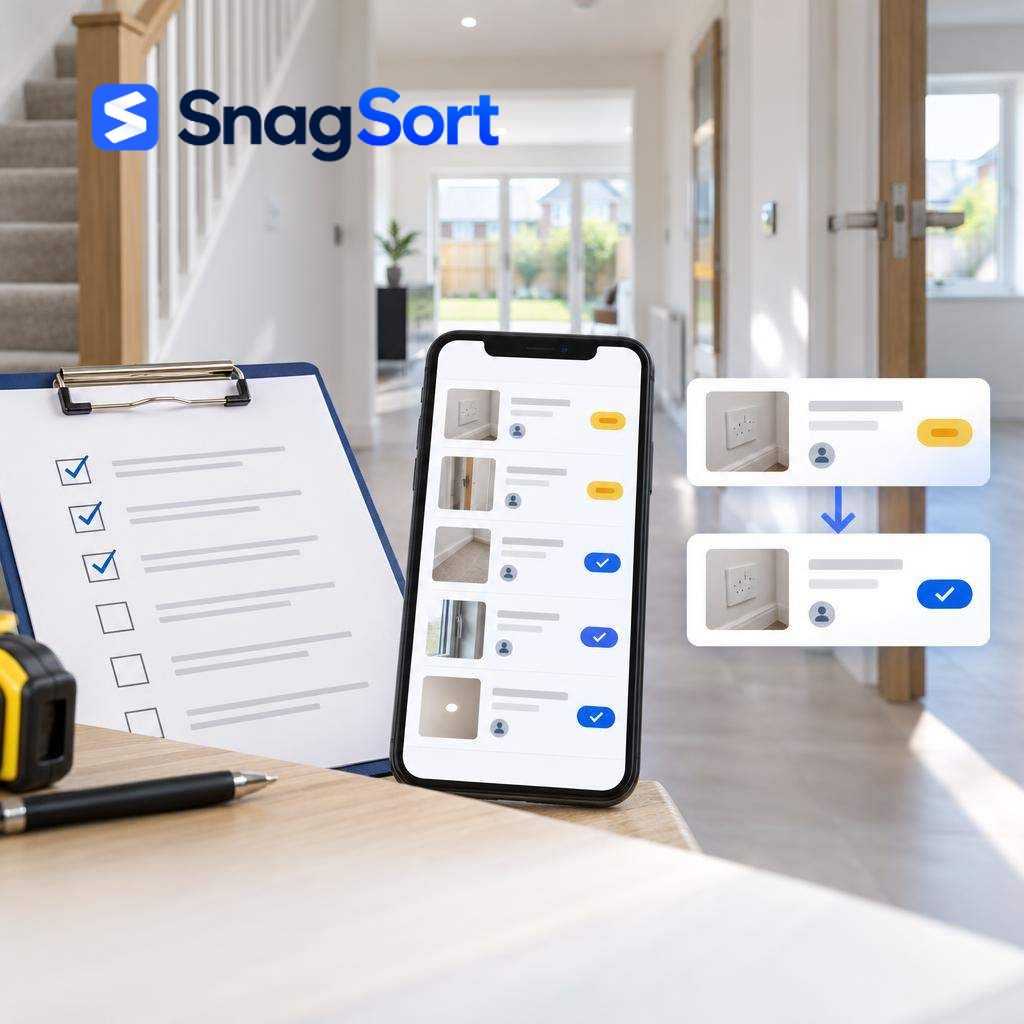
Under the New Homes Quality Code, registered developers must give the buyer the chance to carry out a pre-completion inspection, or appoint a suitably qualified inspector, after the notice to complete and before the completion date. The inspection must follow the NHQB's standard Pre-Completion Inspection Checklist. Where it finds issues that breach the warranty technical standards, the developer should fix them, ideally before legal completion, or within 30 days if that is not possible. The practical job for the site team is to log every finding with its photograph and location, give each one an owner and a date, and keep the evidence that it was put right.
What the Code actually requires
The New Homes Quality Code (V2, March 2026, for homes reserved from 2 March 2026) sets out the inspection in section 2.8. In short:
- Timing. The inspection should take place after the notice to complete has been served and before the completion date, or earlier if the developer and buyer both agree. The Code says the completion notice period is usually expected to be at least 14 calendar days, partly so there is time for the inspection.
- Who can inspect. The buyer can do it themselves or appoint a suitably qualified inspector. That inspector must belong to a recognised professional association with residential surveying experience (the Code gives CABE, CIOB, ICWCI, RICS and RPSA as examples), hold professional indemnity insurance, work within their competency and use only the standard checklist.
- The checklist. The NHQB Pre-Completion Inspection Checklist must be used. It can be reproduced in electronic or digital form, but the checks on the original template must not be changed.
- It does not stop completion. The Code is clear that the checklist is not intended to delay or prevent completion, but the developer must respond to the results in line with the after-sales part of the Code.
At completion, the developer must also have carried out its own final quality assurance inspection and given the buyer a Schedule of Incomplete Work (Home), with timescales for finishing the work or putting right defects.
What a good inspection record contains
The NHQB checklist itself says a completed inspection must include:
- the contact details of the person carrying it out, and their professional association if they have one
- a description of the property, explaining where each room mentioned is located
- any limitations to the inspection, such as weather conditions
- photographs and explanatory notes of every matter identified
- details of any remedial works required
That list is also a good test for your own snag register. If an item has no location, no photograph and no clear remedial action, a trade cannot act on it and a customer care manager cannot prove it was closed. The checklist also sets inspection conditions worth reminding your team about: internal walls are inspected in natural daylight from at least two metres, without shining a light across the surface.
From inspection report to closed snags
The inspection report arrives as a PDF or a set of photographs. The risk is that it sits in an inbox while the 30-day clock runs. A simple routine keeps it moving:
- Log every finding the same day. One row per issue, with plot, room, element, the inspector's photograph and their wording. Keep the original report attached, unchanged.
- Sort snags from everything else. The NHQB homeowner guide lists things that typically are not snags, such as consumables, wear and tear after moving in, and shrinkage cracks narrower than a £1 coin. Emergencies, such as a total loss of power or an uncontainable leak, go straight to the emergency process, not the snag list.
- Give each item one owner and a target date. Split the list by trade so the plasterer, the electrician and the landscaper each see only their own items.
- Ask for evidence, not just "done". A completion photograph taken from the same position as the original makes review quick and is far easier to defend later.
- Review, then close or return. Someone with authority accepts the work or sends it back, and the history stays with the item.
- Keep the buyer updated. If a fix cannot happen within 30 days for a good reason, the Code expects the developer to explain why and give updates at least once a month until it is settled.
Why the 30 days matter
The Code says that in most situations a developer must be able to settle an after-sales issue within 30 days, unless there is a significant reason for a delay. Its glossary adds that if a snag is not put right within 30 days of being reported, the buyer can ask for it to be dealt with under the developer's formal complaints process. The NHQB homeowner guide also tells buyers to keep records of dates, photographs, emails and responses in case a complaint is escalated to the New Homes Ombudsman Service.
In other words, the buyer is being told to keep an evidence trail. The developer's record should be at least as good.
Where SnagSort fits
SnagSort does not replace the NHQB checklist, and it does not decide whether an item breaches warranty standards. It helps with the work that follows the inspection. Site photographs and rough notes become a structured register using the column headings your project already uses. Each contractor gets a scoped portal with only their items, where they can give a programme date and return completion photographs against the snag. Authorised members of the project team then accept, reject or leave each item open, and the close-out evidence stays attached for reports and handover packs.
If your customer care team is still rebuilding inspection reports in a spreadsheet, see how SnagSort works.
FAQ
Is a pre-completion inspection compulsory?
It is not compulsory for the buyer. Under the New Homes Quality Code, registered developers must give the buyer the opportunity to have one, either themselves or through a suitably qualified inspector.
When does the pre-completion inspection happen?
After the notice to complete has been served and before the completion date, unless the developer and buyer agree to an earlier date.
Can the inspector use their own checklist?
No. The Code says inspections must use the NHQB's standard Pre-Completion Inspection Checklist. It can be used in a digital format, but the checks must not be changed.
Can a developer refuse access for the inspection?
The Code allows a developer to refuse access to the buyer or their inspector if they do not take the health and safety precautions the developer has told them to take on a site that is still under construction.
How long does a developer have to fix snags found at the inspection?
The Code says issues that breach the warranty technical standards should be addressed ideally before legal completion, or within 30 days if that is not possible. If there is a good reason for a delay, the developer must explain it and keep the buyer updated.
Which version of the Code applies?
The NHQB says Code V2 (March 2026) applies to homes reserved from 2 March 2026, and V1 (October 2023) to homes reserved before that date. Check which applies to each plot.
Sources
- New Homes Quality Board, New Homes Quality Code, Version 2, March 2026 (sections 2.7, 2.8, 2.11, part 3 and glossary).
- New Homes Quality Board, Pre-Completion Inspection Checklist: House, Version 2, March 2026 (guidance pages).
- New Homes Quality Board, A Homeowner Guide to Snagging, Version 2, May 2026.
- New Homes Quality Board, The New Homes Quality Code web page (version applicability).
This guide summarises published NHQB documents for general information. It is not legal advice. Check the Code version that applies to each home.
Bring the record together
Explore how SnagSort connects site capture, contractor responses and inspection.
See how it works